


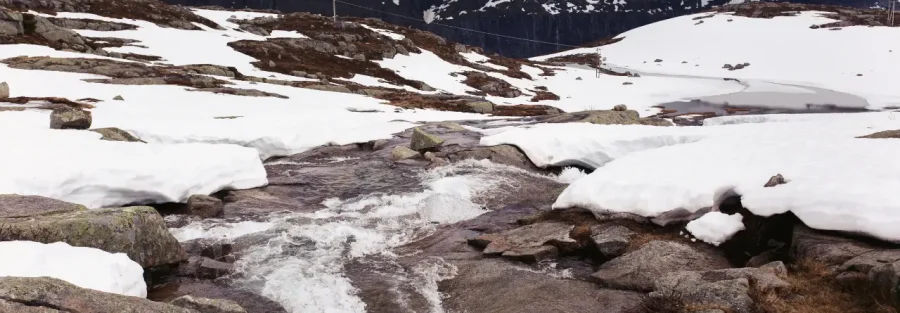
Pakistan is sitting on a climate fault line in the Karakoram, Hindu Kush, and Himalaya. In these mountains, glaciers are melting, advancing, and surging in ways that can dam rivers, build lakes, and turn quiet valleys into flood basins. The latest official figures I found still point to 3,044 glacial lakes in northern Pakistan, with 33 assessed as hazardous and more than 7 million people living at risk downstream.
Stage 01 – Accumulation
The ice is not retreating quietly
Pakistan has 7,253 glaciers. This is not a metaphor for abundance. It is a number with consequences. The Karakoram, Hindukush, and Himalayan ranges collide in northern Pakistan, and where three of the world’s largest mountain systems meet, ice accumulates at a scale that has no parallel outside the Arctic and Antarctica.
Most glaciers worldwide are retreating. Karakoram glaciers are doing something weirder. A documented subset is actually advancing, gaining mass as increased snowfall from a warming Arabian Sea temporarily outpaces melt at elevation. The result is a landscape that is simultaneously losing ice and building more of it, in the same mountain range, at the same time. Scientists call this the Karakoram Anomaly. The locals just call it the mountains behaving badly.
As ice advances, it blocks rivers. Blocked rivers fill up. And 3,033 lakes now sit in northern Pakistan where, a generation ago, there were valleys.
Stage 02 — Surge
Some glaciers move slowly. Some decide not to.
Surge-type glaciers are the Karakoram’s specific contribution to the world’s anxiety. A surging glacier behaves normally for decades, then accelerates to 10 or 100 times its usual speed in a matter of months. Kyagar Glacier surged in 2014, blocked the Shaksgam River completely, and put both Pakistani and Chinese authorities on simultaneous flood alert. The lake it formed was larger than Manhattan.
Shishper Glacier, above Hassanabad in Hunza, has surged every spring since 2019. It creates a seasonal ice dam, backs up the river behind it, and releases a flood each summer when the dam weakens. This is now so routine that locals call it the alarm clock. An alarm clock that destroyed a major bridge in eleven seconds in 2022.
“A GLOF does not give you a weather forecast. One morning a shepherd smells something odd in the valley. By afternoon, his village is under twelve feet of silt.”
Dr. Atta-ur-Rahman, Glaciologist, University of Peshawar
Stage 03 — The Inventory
3,033 lakes. 33 of them are loaded.
In 2020, Pakistan’s UNDP and National Disaster Management Authority conducted the country’s most comprehensive glacial lake survey. The number it returned was 3,033. Of these, 33 were classified as potentially dangerous, meaning a breach was not just possible but statistically expected within 10 to 20 years.
Glacial Lakes by Type in Pakistan Upper Indus Basin Inventory
| Lake Type | Number of Lakes | Share (%) | Total Area (km²) | Share of Area (%) |
| Erosion lakes | 857 | 28.2% | 25.9 | 19.2% |
| End-moraine dammed | 791 | 26.0% | 35.3 | 26.2% |
| Valley lakes | 572 | 18.8% | 45.4 | 33.7% |
| Supraglacial lakes | 438 | 14.4% | 4.5 | 3.3% |
| Cirque lakes | 249 | 8.2% | 13.7 | 10.1% |
| Blocked lakes | 111 | 3.6% | 9.6 | 7.1% |
| Lateral moraine dammed | 26 | 0.9% | 0.3 | 0.3% |
| Total | 3,044 | 100% | 134.8 km² | 100% |
7.25 million people live within direct flood corridors below these lakes. Most of these valleys have one road. In many cases, the road was itself built on the riverbed.
Scale reference
The 2010 Attabad landslide created a single lake 21 kilometres long. It submerged 20 villages. Displaced 6,000 people. Buried the Karakoram Highway under water for five years. There are currently 33 equivalents being pressurised. Not by landslide. By temperature.
Stage 04 — Outburst
The history is already written. In sediment.
Selected GLOF Events, Pakistan — 1929 to 2024
| Year | Event | What Was Erased |
| 1929 | Shishper GLOF, Hunza | 80km debris corridor. Villages buried under 15 metres of silt. No warning of any kind. |
| 1974 | Batura Glacier surge | Karakoram Highway destroyed. The same road that took 20 years and 810 lives to build. |
| 2010 | Attabad landslide lake, Hunza | 21km lake. 20 villages under water. Highway gone for 5 years. 6,000 people displaced. |
| 2022 | 16 simultaneous GLOFs during Pakistan floods | One third of the country underwater. $30 billion in damages. Pakistan had contributed under 1% of global CO2 emissions. |
| 2024 | Shishper, sixth consecutive surge | Seasonal dam, seasonal flood, seasonal destruction. Now annual. Locals track it like weather. |
The Karakoram Highway connects Pakistan to China and carries billions in bilateral trade. It has been destroyed by glacier activity and rebuilt three times in living memory. This is the only road. The rebuilding is not described as remarkable. It has become infrastructure maintenance.
Stage 05 — Warning
45 minutes. In a valley with no road out.
Pakistan has installed early warning sensors on 23 of the 33 high-risk lakes. When water levels rise abnormally, an SMS alert fires to local emergency contacts. The system provides 45 to 90 minutes of warning before a wave arrives.
The villages below these lakes are built against cliff faces. This is not carelessness. It is the only flat land available. A wave travelling at 40 kilometres per hour through a narrow mountain valley leaves 45 minutes of runway for a village with no evacuation road and nowhere flat to run to. The sensors work. The terrain does not cooperate.
“We did not build our villages next to danger. The danger built itself next to our villages. That is a different thing entirely.”
Ghulam Ali, Village Elder, Hassanabad, Hunza
Choke Point
The ice does not consult the calendar
Attabad Lake, the 21-kilometre body of water that swallowed 20 villages in 2010, now has jet skis on it. Tourists come from Gilgit and Islamabad to photograph it. The submerged houses beneath the surface are not visible from a jet ski. The people who lived in them were resettled. Some of them still live 15 years later on the lakeshore, watching visitors photograph their former neighbourhood from a speedboat.
Pakistan’s glaciers are warming at roughly twice the global average rate. The number of dangerous lakes is not fixed at 33. It is a snapshot from 2020. The survey is not updated annually. The ice does not wait for a new survey.
Some of these 3,033 lakes will hold for centuries. Others will not survive the next summer. The ice has no opinion on which is which. It only knows the temperature, and in the Karakoram, the temperature has been the wrong answer for thirty consecutive years.