

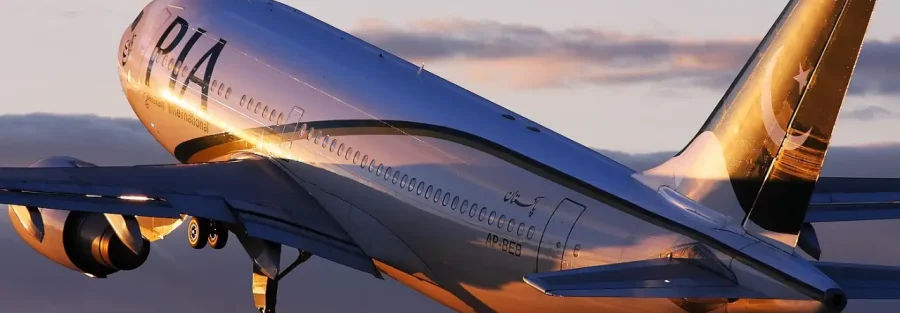
There was a time when Pakistan International Airlines (PIA) was not just Pakistan’s national carrier. It was one of the most respected airlines in the world.
Today, the situation is very different. PIA is currently not allowed to operate flights in the European Union and the United Kingdom, and its reputation has suffered greatly over the years.
But the story of PIA is not only about decline. It is also about a remarkable past — a time when the airline set world records, trained global aviation leaders, and helped launch one of the most successful airlines in history.
Understanding PIA today requires looking at both chapters of its story: the rise and the fall.
When PIA Was One of the Best Airlines in the World
On a January morning in 1962, a Boeing 720 operated by PIA took off from London Heathrow under the command of Captain Abdullah Baig. The aircraft landed in Karachi after 6 hours, 43 minutes, and 51 seconds. At that moment, it became the fastest commercial flight ever recorded between London and Karachi.
More than sixty years later, the PIA’s record still stands. Not because aircraft cannot fly faster today, but simply because no airline has tried to break the record again.
A Global Leader in Aviation
During the 1960s, PIA was considered one of the most progressive airlines in the world. Some of its major achievements included:
- First airline in Asia to operate a jet aircraft
- One of the first Asian airlines to fly to Europe and North America
- Early commercial flights to China
- Famous cabin service and high-quality catering
PIA’s reputation was so strong that other airlines requested PIA to manage catering during Karachi stopovers, because their own service standards were lower. By 1967, the airline had:
- Reached fifth place globally in airline profitability
- Transported over one million passengers annually
Jacqueline Kennedy’s Famous Compliment
In 1967, former US First Lady Jacqueline Kennedy flew on a PIA flight. After landing, she reportedly walked to the cockpit and hugged the pilot, praising the crew as “great people to fly with.”
PIA later adopted this phrase as its official slogan.
For an airline, receiving such praise from a passenger — especially a public figure — was an extraordinary endorsement.
1985: The Airline That Helped Create Emirates
In 1985, a new airline was preparing to launch in Dubai. The airline had:
- Only nine employees
- Two leased aircraft
- A government willing to invest but little operational experience
This airline approached PIA for help. PIA assisted by providing:
- Pilot and crew training
- Operational guidance
- Technical expertise
- Management support
The startup airline’s first flight from Dubai to Karachi was operated using operational practices developed by PIA. That airline was Emirates.
Emirates Today
Today, Emirates is one of the largest and most successful airlines in the world. The airline now:
- Carries over 60 million passengers per year
- Employs more than 100,000 people
- Operates the largest fleet of wide-body aircraft globally
- Consistently ranks among the world’s best airlines
The contrast between Emirates today and PIA today is one of the most striking stories in modern aviation.
The Turning Point: The 2020 Pilot License Scandal
In June 2020, Pakistan’s Aviation Minister addressed the National Assembly and revealed a shocking statistic.
According to the government, around one-third of Pakistan’s commercial pilots held fraudulent licenses.
Some pilots had reportedly paid other people to sit their written exams, yet they continued flying passenger aircraft for years. The announcement immediately raised international safety concerns.
Global Consequences
Within weeks of the announcement:
- The European Union Aviation Safety Agency (EASA) suspended PIA operations in Europe.
- The United Kingdom Civil Aviation Authority imposed a similar ban.
- The United States also restricted operations.
The suspension did not happen because of a single accident. It happened because Pakistan’s own government publicly confirmed major problems in pilot certification. For international regulators, this information required immediate action.
A Slow Institutional Decline
The story of PIA’s decline is not about one moment or one mistake. Instead, it developed slowly over many years. Common issues included:
- Political appointments in management
- Operational decisions influenced by non-commercial interests
- Loss of skilled employees to foreign airlines
- Increasing financial losses
- Aging aircraft fleets and operational inefficiencies
Meanwhile, many PIA-trained professionals moved abroad, joining airlines in the Gulf, Europe, and Asia. In other words, the talent left, but the structure remained.
The Record That Still Tells the Story
The 1962 record set by Captain Abdullah Baig still exists in aviation history.
The aircraft he flew — the Boeing 720 — has long been retired.
The London-Karachi route now typically takes around nine hours, partly due to different flight priorities and routes. But the record represents something deeper. It shows that the same airline that once:
- Set global aviation records
- Trained world-class pilots and crew
- Helped launch Emirates
is today struggling to regain international trust.
What the Story of PIA Really Shows
PIA’s story is not simply about failure. It is about how institutions change over time. The airline did not collapse overnight. Instead, it slowly moved away from the standards that once made it exceptional.
At its peak, PIA helped build the modern aviation industry in Asia and the Middle East. Today, one of the airlines it helped train — Emirates — regularly flies passengers to Karachi through Dubai.
Many travelers choose that route because:
- the service is reliable
- the flights are on time
- the airline’s reputation is strong
And somewhere in that contrast lies the entire story of PIA — not just what it lost, but what it once proved it could be.