


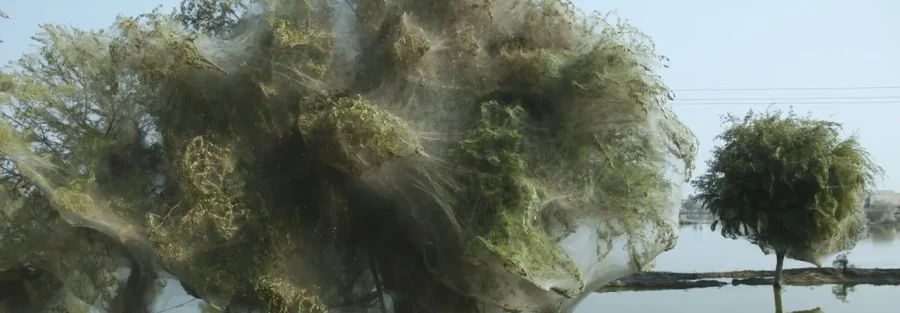
After the 2010 floods in Sindh, Pakistan, something extraordinary happened. Thousands of spiders climbed trees to escape the rising water and spun webs across the branches. Over time, the webs layered together until entire trees appeared wrapped in silk.
These surreal “spider trees” became one of nature’s most fascinating examples of survival and adaptation. What looked almost unreal was actually a powerful story about how nature responds when the environment changes suddenly.
The Floods That Changed the Landscape
The floods of 2010 were among the worst natural disasters in Pakistan’s history. Heavy monsoon rains caused rivers to overflow across large parts of the country. In Sindh, entire villages, farms, and fields remained underwater for weeks.
More than 20 million people were affected, and millions of acres of farmland were submerged. As the water spread across the land, many animals and insects lost their natural habitats.
Spiders were among those forced to find higher ground. With much of the land underwater, trees became one of the few safe places available.
Why the Trees Turned White
When thousands of spiders climbed the same trees, something unusual began to happen. Spiders naturally spin webs to catch food and protect themselves. In this situation, however, the sheer number of spiders meant that webs were being spun constantly.
Each spider created its own silk threads. Over time, these threads overlapped and layered together. Eventually, the branches, leaves, and trunks became covered in a thick network of silk.
From a distance, the trees appeared almost ghostly, as if someone had draped them in white fabric. Photographs of these spider trees soon spread around the world, surprising many people who had never seen anything like it before.
A Natural Survival Strategy
While the spider trees looked strange, they were actually a simple survival response. Spiders needed to escape the floodwaters, and trees provided safety. At the same time, the webs helped them catch insects that gathered around the trees.
In flooded environments, insects often increase in number because stagnant water becomes breeding ground for mosquitoes and other small species. The spider webs helped control these insects naturally.
Some researchers later suggested that the large number of spiders may have helped reduce mosquito populations in certain areas.
Nature’s Ability to Adapt
One of the most remarkable aspects of the spider trees was how quickly they formed. Within weeks of the floods, entire landscapes had transformed. Trees that once looked ordinary were now wrapped in silk, holding thousands of spiders that had adapted to a completely different environment.
This event showed something important about ecosystems. Nature often finds ways to adjust, even under extreme conditions. Animals and insects do not always respond to disasters by disappearing. Sometimes they respond by adapting in unexpected ways.
A Moment That Captured Global Attention
The spider trees quickly became one of the most widely shared natural phenomena from Pakistan’s floods. Photographers, journalists, and researchers traveled to Sindh to see the trees themselves.
Images of silk-covered branches stretching across rural landscapes captured global attention. For many observers, the sight felt almost surreal. Yet it was also a reminder of how interconnected ecosystems are. When one element of the environment changes, countless species adjust their behavior in response.
What the Spider Trees Teach Us
The spider trees of Sindh may have looked strange, but they tell a deeper story about resilience. In the face of rising water and destroyed habitats, thousands of tiny creatures found a way to survive. They climbed higher. They adapted their behavior. And together, they transformed ordinary trees into something extraordinary. Nature often teaches its lessons quietly. Sometimes, all it takes is a flood, a tree, and thousands of spiders to remind us how powerful adaptation can be.